
General considerations for DNA extraction
Introduction
Extraction and purification of nucleic acids is the first step in most molecular biology studies and in all recombinant DNA techniques. Here the objective of nucleic acid extraction methods is to obtain purified nucleic acids from various sources with the aim of conducting a GM specific analysis using the Polymerase Chain Reaction (PCR). Quality and purity of nucleic acids are some of the most critical factors for PCR analysis. In order to obtain highly purified nucleic acids free from inhibiting contaminants, suitable extraction methods should be applied. The possible contaminants that could inhibit the performance of the PCR analysis are listed in Table 1. In order to avoid the arising of a false negative result due to the presence of PCR inhibitors in the sample, it is highly recommended to perform a control experiment to test PCR inhibition. For this purpose, a plant-specific (eukaryote or chloroplast) or species-specific PCR analysis is commonly used.
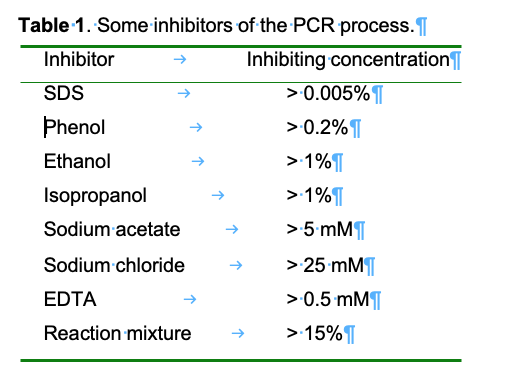
As a wide variety of methods exist for extraction and purification of nucleic acids, the choice of the most suitable technique is generally based on the following criteria:
- Target nucleic acid
- Source organism
- Starting material (tissue, leaf, seed, processed material, etc.)
- Desired results (yield, purity, purification time required, etc.)
- Downstream application (PCR, cloning, labelling, blotting, RT-PCR, cDNA synthesis, etc.)
Extraction methods
The extraction of nucleic acids from biological material requires cell lysis, inactivation of cellular nucleases and separation of the desired nucleic acid from cellular debris. Often, the ideal lysis procedure is a compromise of techniques and must be rigorous enough to disrupt the complex starting material (e.g. tissue), yet gentle enough to preserve the target nucleic acid.
Common lysis procedures include:
- Mechanical disruption (e.g. grinding)
- Chemical treatment (e.g. detergent lysis, chaotropic agents)
- Enzymatic digestion (e.g. proteinase K)
Cell membrane disruption and inactivation of intracellular nucleases may be combined. For instance, a single solution may contain detergents to solubilise cell membranes and strong chaotropic salts to inactivate intracellular enzymes. After cell lysis and nuclease inactivation, cellular debris may easily be removed by filtration or precipitation.
Purification methods
Methods for purifying nucleic acids from cell extracts are usually combinations of two or more of the following techniques:
- Extraction/precipitation
- Chromatography
- Centrifugation
Extraction/Precipitation
Solvent extraction is often used to eliminate contaminants from nucleic acids. For example, a combination of phenol and chloroform is frequently used to remove proteins. Precipitation with isopropanol or ethanol is generally used to concentrate nucleic acids. If the amount of target nucleic acid is low, an inert carrier (such as glycogen) can be added to the mixture to increase precipitation efficiency. Other precipitation methods of nucleic acids include selective precipitation using high concentrations of salt (“salting out”) or precipitation of proteins using changes in pH.
Chromatography
Chromatography methods may utilize different separation techniques such as gel filtration, ion exchange, selective adsorption, or affinity binding. Gel filtration exploits the molecular sieving properties of porous gel particles. A matrix with defined pore size allows smaller molecules to enter the pores by diffusion, whereas bigger molecules are excluded from the pores and eluted at the void volume. Thus, molecules are eluted in order of decreasing molecular size. Ion exchange chromatography is another technique that utilises an electrostatic interaction between a target molecule and a functional group on the column matrix. Nucleic acids (highly negatively charged, anions) can be eluted from ion exchange columns with simple salt buffers. In adsorption chromatography, nucleic acids adsorb selectively onto silica or glass in the presence of certain salts (e. g. chaotropic salts), while other biological molecules do not. A low salt buffer or water can then elute the nucleic acids, producing a sample that may be used directly in downstream applications.
Centrifugation
Selective centrifugation is a powerful purification method. For example ultracentrifugation in self-forming CsCl gradients at high g-forces has long been used for plasmid purification. Frequently, centrifugation is combined with another method. An example of this is spin column chromatography that combines gel filtration and centrifugation to purify DNA or RNA from smaller contaminants (salts, nucleotides, etc.), for buffer exchange, or for size selection. Some procedures combine selective adsorption on a chromatographic matrix (see above paragraph “Chromatography”) with centrifugal elution to selectively purify one type of nucleic acid.
CTAB extraction and purification method
The cetyltrimethylammonium bromide (CTAB) protocol, which was first developed by Murray and Thompson in 1980 (Murray and Thompson, 1980), was successively published by Wagner and co-workers in 1987 (Wagner et al., 1987). The method is appropriate for the extraction and purification of DNA from plants and plant derived foodstuff and is particularly suitable for the elimination of polysaccharides and polyphenolic compounds otherwise affecting the DNA purity and therefore quality. This procedure has been widely applied in molecular genetics of plants and already been tested in validation trials in order to detect GMOs (Lipp et al., 1999; 2001). Several additional variants have been developed to adapt the method to a wide range of raw and processed food matrices (Hupfer et al., 1998; Hotzel et al., 1999; Meyer et al., 1997; Poms et al., 2001).
Principles of CTAB method
Plant cells can be lysed with the ionic detergent cetyltrimethylammonium bromide (CTAB), which forms an insoluble complex with nucleic acids in a low-salt environment. Under these conditions, polysaccharides, phenolic compounds and other contaminants remain in the supernatant and can be washed away. Under low salt concentration (< 0.5 M NaCl), the contaminants of the nucleic acid complex do not precipitate and can be removed by extraction of the aqueous solution with chloroform. The chloroform denatures the proteins and facilitates the separation of the aqueous and organic phases. Normally, the aqueous phase forms the upper phase. However, if the aqueous phase is dense because of salt concentration (> 0.5 M), it will form the lower phase. In addition, the nucleic acid will tend to partition into the organic phase if the pH of the aqueous solution has not been adequately equilibrated to a value of pH 7.8 -8.0. If needed, the extraction with chloroform is performed two or three times in order to completely remove the impurities from the aqueous layer.
Lysis of the cell membrane.
As previously mentioned, the first step of the DNA extraction is the rupture of the cell and nucleus wall. For this purpose, the homogenised sample is first treated with the extraction buffer containing EDTA Tris/HCl and CTAB. All biological membranes have a common overall structure comprising lipid and protein molecules held together by non-covalent interactions.
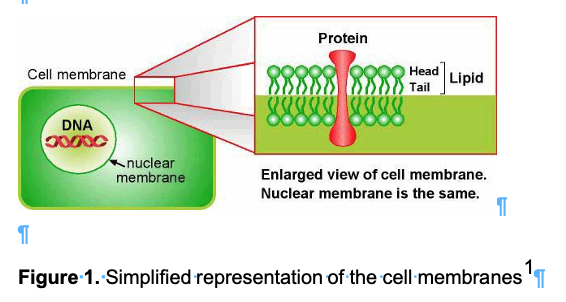
As shown in Figure 1, the lipid molecules are arranged as a continuous double layer in which the protein molecules are “dissolved”. The lipid molecules are constituted by hydrophilic ends called “heads” and hydrophobic ends called “tails”. In the CTAB method the lysis of the membrane is accomplished by the detergent (CTAB) contained in the extraction buffer. Because of the similar composition of both the lipids and the detergent, the CTAB component of the extraction buffer has the function of capturing the lipids constituting the cell and nucleus membrane. The mechanism of solubilisation of the lipids using a detergent is shown in Figure 2.
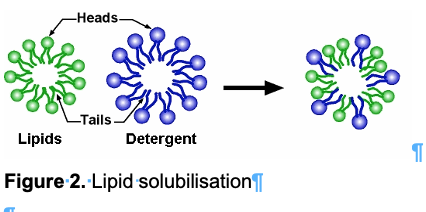
Figure 3 illustrates how, when the cell membrane is exposed to the CTAB extraction buffer, the detergent captures the lipids and the proteins allowing the release of the genomic DNA. In a specific salt (NaCl) concentration, the detergent forms an insoluble complex with the nucleic acids. EDTA is a chelating component that among other metals binds magnesium. Magnesium is a cofactor for DNase. By binding Mg with EDTA, the activity of present DNase is decreased. Tris/HCl gives the solution a pH buffering capacity (a low or high pH damages DNA). It is important to notice that, since nucleic acids can easily degrade at this stage of the purification, the time between the homogenisation of the sample and the addition of the CTAB buffer solution should be minimised. After the cell and the organelle membranes (such as those around the mitochondria and chloroplasts) have been broken apart, the purification of DNA is performed.
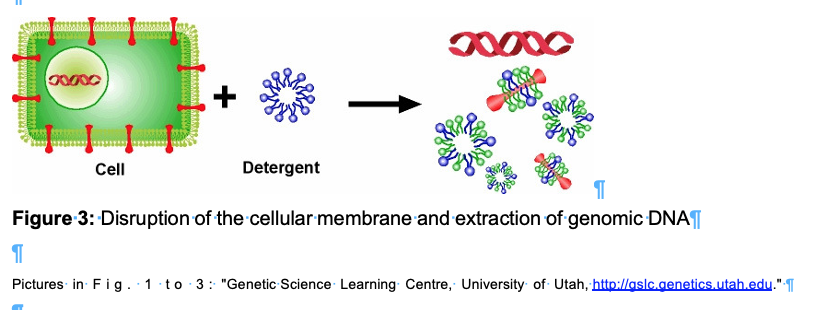
Pictures in Fig. 1 to 3: “Genetic Science Learning Centre, University of Utah, http://gslc.genetics.utah.edu.”
DNA precipitation
In this final stage, the nucleic acid is liberated from the detergent. For this purpose, the aqueous solution is first treated with a precipitation solution comprising a mixture of CTAB and NaCl at elevated concentration (> 0.8 M NaCl). The salt is needed for the formation of a nucleic acid precipitate. Sodium acetate may be preferred over NaCl for its buffering capacity. Under these conditions, the detergent, which is more soluble in alcohol than in water, can be washed out, while the nucleic acid precipitates. The successive treatment with 70% ethanol allows an additional purification, or wash, of the nucleic acid from the remaining salt.